
The Basics of Good Expat Investment Advice
What we will cover in this post
1 An introduction to expat investment advice
2 Rebalancing
2.1 What Is Rebalancing?
2.2 How Rebalancing Works
2.3 Benefits of portfolio rebalancing
2.4 Downsides of portfolio rebalancing
2.5 6 Portfolio Rebalancing Tips
2.6 Rebalancing – Conclusion
3 Diversification
3.1 The power of diversification: How to protect your expat retirement
3.2 Themes
4 Further reading:

TL;DR
Successful investing as a British expat starts with understanding the basics rather than chasing the latest market trends. A well-diversified portfolio, aligned with your goals, risk tolerance, time horizon, and country of residence, is usually far more important than trying to pick winning investments. Cross-border tax rules, currency exposure, and future plans to return to the UK should all form part of your investment strategy. Building strong foundations today can help you grow and protect your wealth over the long term.
Starting Your Investment Journey Abroad? Build Your Strategy With Confidence
Investing successfully as a British expat involves far more than selecting individual funds or shares. The most effective investment strategies are built around your long-term goals, tax position, retirement plans and the country in which you live. Taking the time to develop a clear strategy from the outset can help you make more informed decisions and avoid costly mistakes later on.
Investing is about more than choosing individual funds or shares. A successful investment portfolio should reflect your personal objectives, attitude to risk and the role your investments will play in supporting your future lifestyle.
Your investment strategy should reflect your financial goals, tax position and country of residence. Tax rules, local regulations and future plans—such as returning to the UK or retiring abroad—can all influence which investment approach is most appropriate for your circumstances.
A well-structured plan helps you invest with greater confidence. Looking at your pensions, investments, retirement objectives and wider financial position together creates a joined-up strategy that can adapt as your circumstances change over time.
A Discovery Call gives you the opportunity to discuss your objectives before making important investment decisions. Whether you’re investing for the first time, reviewing an existing portfolio or planning your financial future overseas, a conversation can help you understand your options and make decisions with greater confidence.
If you’re ready to start investing—or want to ensure your current investment strategy is aligned with your long-term financial goals—book a Discovery Call to discuss your circumstances and explore the most appropriate way forward.
An introduction to expat investment advice
Historically, expat investment advice has been characterised by the focus on the sale of a financial product, e.g. a pension plan or an investment fund.
While products are, obviously, a necessary feature of a wider holistic financial planning strategy, good quality expat investment and retirement advice encompasses much more than simply selling products.
In this post I will address the main issues that you should consider when planning your investments.
Rebalancing
What Is Rebalancing?
Rebalancing is the process where the weightings of the investments within a portfolio are reset back to their original levels.
It involves periodically buying or selling assets within a portfolio in order to maintain an original or desired level of asset allocation or risk.
For example, say an original target asset allocation was 60% stocks and 40% bonds (i.e. 60/40).
If the stocks performed well during a given period, it could have increased the stock weighting of the portfolio to 70%. The investor may then decide to sell some stocks and buy bonds to take the portfolio back to the original target allocation of 60/40.
Alternatively, in a period of market stress (e.g. 2008/2009 or the current Coronavirus crisis), where stocks fall sharply and their weighting of the portfolio drops to 50%, the investor could decide to sell some bonds and buy stocks at the lower level and take the portfolio back to the original 60/40 allocation.
How Rebalancing Works
There are various approaches to rebalancing with Periodic or Calendar Rebalancing being the simplest approach.
Periodic/Calendar Rebalancing
This strategy involves analyzing the investment holdings within the portfolio at predetermined time intervals and adjusting to the original allocation at a desired frequency.
Monthly and quarterly reviews are typically preferred, as a yearly approach would potentially allow for too much portfolio drift in the meantime.
The ideal frequency of rebalancing should be based on time constraints, transaction costs and allowable diversion from the target.
A big advantage of calendar rebalancing over more responsive methods is that it is significantly less time consuming and costly for the investor since it involves less trades and is carried out at pre-determined dates.
The downside to calendar rebalancing, however, is that it does not allow for rebalancing at other dates even if the market moves significantly.
Dynamic Rebalancing
A more dynamic approach to rebalancing focuses on the allowable percentage holding of each asset within a portfolio.
Every asset class, or individual security, is given a target weight and a corresponding tolerance range.
For example, an allocation strategy might include the requirement to hold 30% in domestic equities, 30% in international equities and 40% in government bonds. Within this portfolio, each asset class will have a band of, say, plus or minus 5%.
In this example, domestic and international equities could both fluctuate between 25% and 35%, while 35% to 45% of the portfolio would need to be allocated to government bonds.
When the weight of any one holding moves outside of the allowable band, the entire portfolio would be rebalanced to reflect the initial target composition.
The advantage with this method is that you are constantly buying low and selling high and potentially taking advantage of opportunities often in a whipsawing market.
Additionally, in calmer markets, you may not need to touch your portfolio for some time.
Benefits of portfolio rebalancing
It helps to balance risk and reward
Ultimately, asset allocation is all about balancing risk and reward.
Inevitably, over time, some asset classes (usually stocks) will perform better than others. This can cause your portfolio to be skewed towards an allocation that takes too much risk or too little risk based on your financial objectives.
This is great if the market continues to rise but you would then see a more pronounced decline in your portfolio when the market experiences a sharp correction.
Discipline
Rebalancing imposes a level of discipline in terms of selling a portion of your winners and putting that money back into asset classes that have underperformed.
This may seem counterintuitive but all markets evolve over time.
What is hot at one time does not remain so. Remember back in the 1990’s when tech stocks were all the rage? Those that did not rebalance during those times would have seen big losses when the bubble eventually burst.
Rebalancing can help save investors from our own worst instincts as it is often tempting for us to let our top performing holdings and asset classes run when the markets seem to keep going up.
Ideally investors should have a written investment policy that outlines their target asset allocation with upper and lower percentage ranges. Violating these ranges should trigger a review for potential portfolio rebalancing.
Rebalancing helps you stay on track with your financial plan
Investing success is not the be all and end all. It is simply a tool to help ensure that you meet your financial goals and objectives.
A properly constructed financial plan will contain a target asset allocation and an investment strategy tied to your goals, your timeframe for the money and your risk tolerance.
Periodic portfolio rebalancing is vital to maintaining an appropriate asset allocation that is in line with your financial plan.
It is a great way to take advantage of falling markets.
As investors we all know the theory that we should buy low and sell high and we all plan to do so.
“Everyone has a plan until they get punched in the mouth”.
Mike Tyson
However, when markets are crashing as they did in 2008/2009 or during the current Coronavirus crisis, actually pulling the trigger and putting new money into the market is difficult.
Having a written rebalancing strategy in place (or even better, a fund that does it without you even having to act) allows you to more easily take advantage of such rare buying opportunities.
Real People, Real Results
“In just one year Ross has helped me enormously, firstly and most importantly to better understand my financial position, rather than putting it off, to look at where I want to get to and start making some simple changes in order to achieve this. I would not hesitate in recommending Ross.”
— Paul Martingell
More TestimonialsDownsides of portfolio rebalancing
Selling winners
One of the disadvantages of rebalancing is that sometimes you cut the legs out from under the asset class before it has finished its bull run.
Tax
There can be important tax considerations in rebalancing when investors do it in taxable accounts. The tax impact isn’t as relevant in tax advantaged accounts like pensions or ISAs.
Personal tax can be avoided if the assets are rebalanced within a multi-asset fund.
Costs
The buying and selling of assets typically incurs costs. Unnecessary rebalancing therefore leads to unnecessary costs.
6 Portfolio Rebalancing Tips
1. Set a target asset allocation
Your asset allocation should be an extension of a target asset allocation from your financial plan and/or a written investment policy.
This is the target asset allocation that should be used when rebalancing your portfolio.
2. Establish a time frame to rebalance
Ideally you are reviewing your portfolio and your investments on a regular basis.
As part of this process you should incorporate a review of your asset allocation.
This might be semi-annually for example. I generally suggest no more frequently than quarterly. An exception would be after a precipitous move up or down in the markets.
3. Take a holistic view of your portfolio
Ideally, when rebalancing your portfolio take a total portfolio view. I.e. look at all of your investment accounts, including insurance bonds, investment platforms and pensions.
Doing so will allow you to be strategic and tax-efficient when rebalancing. It will also ensures that you are not taking too little or too much risk on an overall basis.
4. Incorporate new money
If you have new money to invest, take a look at your asset allocation first. Then use these new funds to shore up portions of your asset allocation that may be below their target allocation.
5. Don’t think you are smarter than Mr. Market
I know it is tough to sell winners and then invest that money back into portions of your portfolio that haven’t done as well.
However, portfolio rebalancing is part of a disciplined investment process.
It can be tempting to let your winners run, but too much of this can skew your allocation too far in the direction of stocks and increase your downside risk.
If you think you can do better than the collective knowledge of the market, trust me, you can’t.
Ask yourself, how devastating the impact of being wrong could be?
Just ask those who bought into the mantra “…it’s different this time…” before the Dot Com bubble burst.
6. Use autopilot
For most investors, the best solution is to invest in a single fund that is well diversified, holds multiple assets and that rebalances dynamically.
This removes any personal tax issue as the assets are bought and sold within the fund.
It removes the need to make active decisions. You don’t have to face the test of willpower in deciding to sell an asset that is performing strongly. You don’t have to pull the trigger on buying stocks when the market has dropped 30% and no one knows what is going to happen next.
Finally, it is the simplest solution and simplicity, in my view, is one of the most underrated factors in investing.
Rebalancing – Conclusion
Regular portfolio rebalancing helps reduce downside investment risk. It also ensures that your investments are allocated in line with your financial plan.
It also can help investors impose, directly or indirectly, an important level of discipline on themselves.
While it is possible to go without rebalancing a portfolio, this would generally be ill-advised.
Rebalancing gives investors the opportunity to sell high and buy low, taking the gains from high-performing investments and reinvesting them in areas that have not yet experienced such notable growth.
Not Sure How to Start Investing as an Expat?
Beginning your investment journey can feel overwhelming, particularly if you’re living overseas and navigating different tax systems, currencies and financial regulations. While there is no single investment strategy that suits everyone, having a clear financial plan provides a solid foundation for making confident long-term decisions.
Every investor has different objectives and risk tolerance. Some people invest to build long-term wealth, while others focus on generating retirement income, preserving capital or leaving a financial legacy. Your investment strategy should reflect your personal goals rather than simply following market trends.
The right investment strategy depends on your personal circumstances. Your country of residence, tax position, retirement plans, family commitments and future ambitions all influence how your investments should be structured. Taking these factors into account helps create a strategy that supports your wider financial objectives.
Good investing starts with a clear financial plan. Looking at your investments alongside your pensions, tax planning, retirement goals and estate planning helps ensure each financial decision contributes towards your long-term success rather than being made in isolation.
Independent financial advice can help you invest with confidence. Whether you’re investing for the first time or reviewing an existing portfolio, professional advice can help you understand your options, manage investment risk appropriately and build a strategy designed around your individual circumstances.
If you’re unsure where to begin—or want reassurance that your current investment strategy remains appropriate—book a Discovery Call to discuss your objectives and explore the most suitable approach for your long-term financial future.
Investing Is Only One Part of Your Financial Plan
Successful investing is about much more than selecting funds, shares or investment products. The strongest investment strategies are built around your long-term financial objectives and work alongside your pensions, tax planning, retirement goals and estate planning. By taking a holistic approach, you can ensure every financial decision contributes towards the future you want to achieve, wherever you choose to live.
Aligning Investments With Your Financial Objectives
Before choosing investments, it is important to understand what you are investing for. Whether your objective is building wealth, generating retirement income, funding your children’s education or creating financial security, your investment strategy should be tailored to support those goals rather than simply chasing the highest returns.
Building Investments Around Your Retirement Plans
Investments and retirement planning should work together. As retirement approaches, your investment strategy may need to evolve to reflect changing income needs, risk tolerance and withdrawal plans. Coordinating your investments with your pensions helps create a more sustainable long-term retirement strategy.
Tax-Efficient Investing for British Expats
Living overseas can significantly affect how your investments are taxed. Tax residency, local legislation and any future plans to return to the UK should all be considered when building an investment portfolio. Reviewing your investments alongside your wider tax position helps improve long-term efficiency while reducing unnecessary tax liabilities.
Managing Investment Risk Over Time
Every investment carries some degree of risk, but that level of risk should be appropriate for your personal circumstances and financial objectives. Regularly reviewing your portfolio helps ensure it continues to reflect your attitude to risk and adapts as markets and your own circumstances change.
Coordinating Pensions and Investments
Many British expats build wealth through both pensions and non-pension investments. Looking at these together helps create a balanced financial strategy, allowing each part of your portfolio to complement the other while supporting your retirement objectives.
Estate Planning and Passing on Wealth
Investments should also form part of your wider estate planning. Reviewing your investment portfolio alongside beneficiary nominations, inheritance planning and your overall financial arrangements helps ensure your wealth is transferred according to your wishes while supporting future generations.
Reviewing Your Investment Strategy as Life Changes
Financial planning is an ongoing process rather than a one-off decision. Marriage, retirement, moving country, changes in tax residency or significant market events can all affect whether your investment strategy remains appropriate. Regular reviews help keep your financial plan aligned with your evolving goals.
Why Holistic Financial Planning Delivers Better Outcomes
The strongest financial plans bring every element together. Looking at your investments, pensions, retirement planning, tax position and estate planning as one joined-up strategy helps you make better-informed decisions and provides greater confidence that your finances are working towards your long-term objectives.
Successful investing is not simply about achieving strong returns. Reviewing your investments alongside your pensions, tax planning, retirement objectives and estate planning helps ensure every financial decision contributes towards your long-term goals while adapting as your circumstances evolve.
Diversification
The power of diversification: How to protect your expat retirement
“Holding a diversified portfolio of asset classes and investments means you don’t have to try to pick and choose the best performing section each year (which is impossible to do anyways).”
– Ben Carlson @awealthofcommonsense
This chart is one of my favourite ways of demonstrating the importance of diversification for those who are thinking about retirement or who have already hung up their spurs.
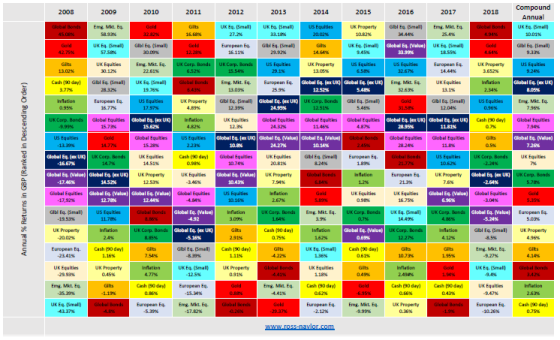
Going back to the financial crisis in 2008, it shows the annual returns for 15 different asset groups, including stocks in different regions and with varying market capitalisations, both corporate and government bonds, cash, gold and real estate. For comparison, I have also added inflation figures to the mix.
Themes
If we dig into the data, some interesting themes emerge:
Just because an asset performed well in any given year, doesn’t mean that it will continue to do so. Since 2008, there were 15 instances where an asset in the top 3 performers one year was also in the bottom 3 either the following year or the preceding year.
Cash isn’t king. There have been a couple of years where stocks performed poorly and holding cash paid off. During the financial crisis and last year (2018) being good examples. This is why holding a couple of years’ worth of cash is so important if you are in retirement. It means that if markets do fall, then you don’t have to sell declining assets to fund your lifestyle.
However, over the medium to long term, the data shows that cash is a poor investment as it loses value relative to the rising cost of living.
No rhyme or reason. Over the 11 years in the chart, 9 different assets held the top performer slot. Also, there was only one occasion, 2012 and 2013, where the top performing asset was the same in consecutive years.
This is because different assets and investments have their own characteristics and perform better or worse in different economic environments.
The power of diversification is that you don’t have to try to pick and choose which sector will perform best in any given year. Done correctly, you should always own some assets that are performing reasonably well.
Common Investment Mistakes British Expats Make
Building wealth through investing is a long-term process, but many investors make avoidable mistakes that can reduce returns or expose them to unnecessary risk. For British expats, investing can be even more complex because different tax systems, currencies and regulations all need to be considered. Understanding the most common pitfalls can help you develop a more resilient investment strategy and make better-informed financial decisions.
Investing Without Clear Financial Goals
Successful investing begins with knowing what you want your money to achieve. Whether your objective is funding retirement, building long-term wealth, generating income or leaving an inheritance, your investment decisions should always support those goals rather than simply chasing investment performance.
Taking Too Much or Too Little Investment Risk
Some investors take unnecessary risks in pursuit of higher returns, while others become so cautious that their investments struggle to keep pace with inflation. Finding an appropriate level of investment risk helps create a portfolio that reflects both your financial objectives and your tolerance for market fluctuations.
Ignoring Tax Implications in Different Countries
Tax rules can vary significantly depending on where you live. British expats should understand how investment income, capital gains and withdrawals may be taxed in their country of residence, as well as the implications of any future plans to return to the UK. Tax-efficient investing should form part of every long-term financial strategy.
Concentrating Investments in One Market or Asset Class
Relying too heavily on a single investment, sector or geographical market increases the risk that poor performance in one area could significantly affect your overall portfolio. Diversification helps spread investment risk and provides greater resilience through changing market conditions.
Forgetting to Review Investments Regularly
An investment strategy that was appropriate several years ago may no longer reflect your current financial goals, retirement plans or personal circumstances. Regular reviews help ensure your portfolio continues to align with your objectives and remains suitable as your life evolves.
Overlooking Pension and Retirement Planning
Investments should complement your pensions rather than compete with them. Looking at both together helps create a more balanced retirement strategy, allowing different assets to work together to provide sustainable long-term income.
Reacting Emotionally to Market Movements
Markets naturally rise and fall over time. Making investment decisions based on short-term market movements or negative headlines can often lead to poor long-term outcomes. Maintaining a disciplined investment approach focused on your long-term objectives is generally more effective than reacting emotionally to market volatility.
Investing Without Professional Financial Advice
While many people are comfortable managing some aspects of their finances independently, significant investment decisions often benefit from professional guidance. Independent financial advice can help you build an investment strategy that reflects your objectives, tax position, retirement plans and overall financial circumstances while avoiding costly mistakes.
Successful investing is built on a disciplined long-term strategy rather than short-term market movements. Reviewing your investments alongside your pensions, tax planning, retirement objectives and estate planning helps ensure your financial decisions remain aligned with your long-term goals wherever you live.

Talk to an Expert
Building wealth as a British expat involves far more than simply choosing investments. A successful strategy needs to consider your pensions, tax residency, retirement plans and long-term financial goals, ensuring your investments continue to work effectively wherever life takes you.
I'm Ross Naylor, a UK-qualified Chartered Financial Planner and Pension Transfer Specialist with nearly 30 years' experience helping British expats develop investment strategies that are aligned with their retirement planning, tax position and wider financial objectives. My focus is on creating straightforward, well-diversified plans designed to provide long-term financial confidence rather than unnecessary complexity.
I firmly believe your location in the world should never be a barrier to expert, impartial and transparent financial advice you can trust.
Whether you're investing for the first time, reviewing an existing portfolio, coordinating your investments with your pensions, planning for retirement overseas or preparing for a future return to the UK, I'll help you build a financial strategy that supports your long-term goals while adapting as your circumstances change.
Book a Discovery Call